|
 Following the amazing success of the original Jason's Cradle, the enterprising Nigel Watling of Land and Marine Products has launched another version of his novel rescue system.
 Jason's Cradles are now commonplace around the world, with thousands of units having been sold since the system's introduction just a few years ago. Most standby vessels in the North Sea have them fitted as standard, the Royal Navy took delivery of 150 units in February, the police, coastguard and fire brigades have them, and the United States Navy also uses them. The new product is aptly called the Quayside Recovery Unit - and Jason Watling, son of Nigel Watling, kindly laid on a special demonstration for us in Southampton Docks. Highly portable The system is highly portable and lightweight. It can be assembled at the quayside within 3-5 minutes. The whole thing only weighs about 80kg, but it can lift up to 150kg through a height of up to 70ft. And it is, of course, HSE and CE approved. The first of the new units have already been snapped up by the Grampian Police Force. This product is unique in its rapid deployment and ability to recover a casualty in a horizontal position from the water alongside a steep quay wall. This is particularly important when rescuing casualties who are exhausted and possibly hypothermic. In the past, such casualties have occasionally died during recovery when they were hauled out of the water in a vertical position due to a sudden drop in blood pressure on leaving the water.  The demonstration at Southampton was both impressive and convincing. The components all slotted together in just 4 minutes at the quayside without the need to do up one nut-and-bolt. A volunteer casualty was dispatched into the cool waters of Dock Number 4 about 30ft below the level of the quayside and the cradle was winched down using the 'speed' facility to the water. The cradle sank just below the surface, with just its upper flotation collar remaining on the surface.
 Security
Our 'casualty' was very co-operative for the purpose of the demonstration, and slid himself easily into the security of the cradle. A whip-line secured to one end of the cradle gave the configuration added stability to prevent any unwanted swinging or rotation of the unit. Once in the secure embrace of the cradle, the non-slip winch was turned by hand and the casualty gently ascended the 30ft or so up the side of the quay wall. On arrival, the davit was swung around to bring him inboard. It was simplicity itself, and fast too! 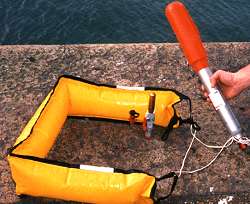 As a special treat, we were also given a demonstration of a Rescue Rocket which is another rescue system in the product range of Land and Marine Products. This was a pneumatic line deployment system. The rocket propellant was simply compressed air escaping from a small high-pressure cylinder, so there was no fire risk.
 The effectiveness was remarkable. To operate the system, the safety pin was first removed, the unit was held at an angle of 35-45 degrees, and the trigger squeezed. The projectile instantly shot off with no perceptible recoil and travelled comfortably 150-220ft.  When it landed in the water, the 'projectile' automatically and instantly inflated itself into a flotation sling with flashing strobe light.
This product will be in service with the MoD later this year. Many hundreds of units are already in use in Japan, Malaysia and the offshore oil and gas industry. Details - Land and Marine Products Ltd, Tel: +44 01420 474484, Fax: +44 0 1420 489002, E-mail: jasonscradle@gml.co.uk, Web: www.jasonscradle.co.uk  © 2000 Underwater World Publications Ltd. |