|
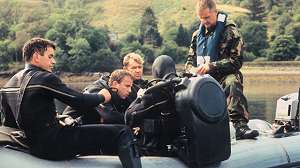 To support the front-line by providing the world's best diver training. That's the mission statement of the UK's Joint Service Defence Diving School, which has its base at Horsea Island, near Portsmouth. UCI editor John Bevan takes a tour. The early days The inventors of the diving helmet and dress, John and Charles Deane, first introduced their revolutionary equipment to the Admiralty in 1831. A special demonstration was provided for the Chief Engineer and Mechanist to the Royal Navy, Simon Goodrich, with a dive at the entrance to Portsmouth Harbour. The Admiralty was singularly unimpressed. A second attempt to open the eyes of the Admiralty to the potential benefits of using divers was made the following year, when the Deane brothers visited Sheerness Dockyard and demonstrated their abilities to Sir James Beresford himself. Again, the Royal Navy failed to see any merit in the diving equipment. It was not until Colonel Pasley of the Royal Engineers saw the equipment in use in 1838 that the huge benefits of helmet diving were appreciated by the military. When Colonel Pasley took on the awesome responsibility of clearing the wreck of HMS Royal George in 1839, following the failure of the Royal Navy to clear it the previous year, he began the project using civilian divers from Whitstable, Kent. The Whitstable divers were so productive that the next year, 1840, Col Pasley decided the Royal Engineers should adopt the technique. A small group, including some carefully selected Royal Sappers and Miners who were working on the Royal George at Spithead, was introduced to diving. They were instructed by George Hall, a famous civilian diver from Whitstable. Three years later, when the wreck had been almost entirely removed, the Royal Engineers and Royal Sappers and Miners had established themselves as competent and professional divers in their own right. Colonel Pasley's next initiative was to try (once more) to persuade the Admiralty to adopt the new art of helmet diving. This time they did so, albeit reluctantly. Sir Thomas Hastings, who was then the captain of HMS Excellent, the floating gunnery school at Portsmouth, bowed to pressure from the Admiralty. He grudgingly introduced a diving training section into his gunnery school onboard Excellent in 1844. The first naval divers were subsequently trained by Royal Engineers and Royal Sappers and Miners. Back to the present  Now, in the year 2000, 166 years later, we find the Royal Engineers and the Royal Navy divers being trained alongside each other, back at HMS Excellent. But Excellent is no longer a floating hulk. It is an extensive shore establishment on Whale Island, which nestles in the sheltered waters of Portsmouth Harbour.
The diving school itself is an outpost of HMS Excellent on the neighbouring Horsea Island, which is home to a 1000-metre-long artificial lake built by the Royal Engineers in the 1880s with the assistance of convict labour as a test facility for early torpedoes. Since then, Horsea Island has been in continuous use by the military. During WW2, the lake provided the training facility for the heroic 'Charioteers'. Facilities It is this lake that now provides the main open-water training facility - with its selection of sunken objects, including a helicopter, various armoured vehicles, mines and concrete pipes. Shore facilities include jetties, a 5-metre tank, recompression chambers, an underwater engineering facility, a diving clothing store and laundry, workshops, classrooms, conference rooms, catering and showers.  Though still referred to as Horsea Island, an extensive land reclamation scheme has converted the area into a suburb of Portsmouth, alongside the city's prestigious yachting marina, Port Solent. Visitors should not be alarmed when minor fires suddenly break out on the island. For this is because it is also the home of the RN Fire Fighting School. Overall, the island has changed significantly (for the better) since I completed my Ship's Diver Officer Course there back in the winter of 1968.
The Joint Service Defence Diving School (DDS) was officially formed by the amalgamation of the RN and Army diving schools on 1 September 1995 following the closure of HMS Nelson, at Gunwharf Site (formerly HMS Vernon) in Portsmouth. It is run as a Single Service sponsored (RN) Defence Training Establishment and includes RN, Army and civilian elements.  To maintain a balance and effective coordination between the two services, the post of Commanding Officer alternates between the RN and Army. He is responsible for a staff of 111 drawn from the RN, Army and Civil Service.
The school's proud mission statement is "to support the front-line by providing the world's best diver training". This translates into the primary aim "to make our contribution to the cost effective delivery and maintenance of Military Capability at the front-line by providing the required number of appropriately trained divers". As I witnessed a course of RN divers going through some specialised engineering training, I could not help but be impressed by the extremely high standard of the instruction and the facilities. Their mission statement was being comfortably met. "Excellence" is the name of the game at Excellent. In addition to the British military training programme, foreign forces also send military personnel for diver training at this superb establishment.  The RN Training Wing provides the training for their career divers - Clearance Divers, or CDs - who are involved mainly with Mine Counter Measures and Explosive Ordnance Disposal, and for Ship's Divers who are part-time divers. The training covers all aspects of diving including air and mixed gas in self-contained and surface-supplied equipment, specialist equipment, and the operation of recompression chambers. Instruction is also given in Breathing Apparatus Maintenance. When the training goes into deep water, students travel to Portland, Wyke Regis, Plymouth or the Western Isles as necessary. The throughput of RN trainee divers (of all classes) is currently about 280 per year, made up of some 200 Ship's Divers and 80 Clearance Divers. The Army  The Army Training Wing provides six different types of scheduled courses. In addition to the self-contained and surface-demand diving equipment instruction, training is also given in the use of a range of underwater tools, cutting and burning techniques, and scaffolding and subsurface construction. The Army currently trains about 250 divers a year in underwater engineering and combat engineering techniques.
Commercial Availability  Readers of Underwater Contractor International may well be interested to note that the facilities at the DDS are now accessible for civilian use. This is through a partnering initiative using a joint venture company called Flagship Training Ltd.
The unique trials facility is available for all forms of commercial underwater test and evaluation projects. Commercial diver training and underwater research are expected to be added to the applications for the facility in the near future. Recreational diving is managed by the commercial organisation Horsea Island Dive Centre, which is operational at weekends. Acknowledgements I am most grateful to the Commanding Officer of the Defence Diving School at Horsea Island, Lt Col Robbie Hall QGM RE, for permission to visit the school. I would also like to thank Major David Jones RE, Diving Training Officer (Army), who was my host and guide for the extensive tour of the facilities, and Lt John Herriman RN for the most informative and interesting insight into current military diver training.  © 2000 Underwater World Publications Ltd. |