|
 When UCI Editor John Bevan visited the Southampton Oceanography Centre, he discovered some exciting and surprisingly varied projects being conducted by the scientists of the UK's oceanographic centre of excellence. Having both the University of Southampton's School of Ocean and Earth Science and the Natural Environment Research Council (NERC) under one roof - along with ships and world-class research facilities - the Southampton Oceanography Centre (SOC) is ideally placed to undertake ocean research on a worldwide basis. Research at SOC is organised around eight major themes, which cover the broad range of marine and ocean sciences. All SOC scientists are signed up on one or more of these themes, which are designed to serve as a focus for stimulating new research programmes and for disseminating information on those already under way. The eight themes are:
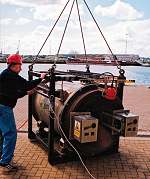
Last year, UCI reported on the pioneering and world-class projects being carried out by Dr Gwyn Griffiths and his team of scientists with Autosub (see Issue 2, Vol 4, 2000). Since our report, Autosub has had a narrow escape, has made its mark at the National Science Museum in London, and is now travelling to Antarctica for a series of missions exploring the waters under the ice shelves and icebergs of the frozen continent. Of this, more later. For although Autosub is undoubtedly the most high-profile of SOC's current activities, it is just one of several ground-breaking areas of development. Among other fascinating projects are the HOLOMAR 3D underwater camera, the Atlantic Margin Environmental Surveys, and a new state-of-the-art deepwater ROV. HOLOMAR The HOLOMAR project, headed at SOC by Dr Richard Lampitt, incorporates the world's first 3D-hologram camera. This amazing piece of equipment, weighing over two tonnes and launched just a few months ago, can take 45 holographic images of a volume of water roughly one metre-cube on a single dive.
'Optical sections' can be taken at any point in an individual plane, and the dimensions, shape and relative position of particles and organisms trapped in a moment of time can be investigated 'at leisure'. The camera has taken three years to develop at a cost of about £1m. This ground-breaking research will ultimately find applications in the offshore oil industry. SOC says that HOLOMAR represents a powerful new tool, the potential of which it is only just beginning to explore. ATLANTIC MARGIN SURVEYS Dr Brian Bett, Principal Scientist, is in charge of this extremely ambitious project which has successfully surveyed a large area of the continental shelf margin north and west of Scotland. The purpose of the survey was to establish a biological baseline for the area, against which any future changes can be gauged. The principal tool for the survey was the SOC's "TOBI" side scan fish together with seabed photography and biological, chemical and geological analyses of samples taken from the seafloor. Dr Bett gave a detailed presentation of some of the findings of this project at the recent SUT AGM held on HQS Wellington on London's Thames embankment. Dr Bett said that he was particularly concerned with the large-scale destruction of the seabed habitat by deep-water trawling, specifically by non-UK fishing fleets. He made an impassioned plea for better protection of the seabed resources and added his weight to the growing call for the building of artificial reefs using redundant oil platforms and other large-scale pieces of hardware. DEEPWATER ROV Professor Paul Tyler described how the SOC is about to go out to contract for the building of its own deepwater ROV. The plan is to commission a full-ocean-depth (6500m) vehicle to investigate the mid-Atlantic hydrothermal vents that are becoming increasingly appreciated as significant contributors to ocean ecology. A major award from the Joint Infrastructure Fund (JIF) is financing the deep-roving vehicle. The bid for funding the project was led by Professor Tyler, who is based at SOC's School of Ocean and Earth Science, along with Dr Chris German (Chair of SOC's Research Development Committee) and Dr Griffiths. Professor Tyler said: "The vehicle we plan to acquire will be a state-of-the-art ROV, which will be able to explore, observe and conduct experiments down to depths of 6500m. This will be the first such advanced underwater vehicle of its kind in the UK and will benefit a generation of talented marine scientists." marine science technology pool. This will give UK marine scientists access to over 50 per cent of the Earth's surface that lies below 3000m. "The acquisition of an ROV for the UK's science community is vital in order to maintain our international reputation for innovative research in marine and earth science and technology," said Professor Tyler. The JIF initiative is a collaborative funding venture involving the Department of Trade and Industry, the Wellcome Trust, the Higher Education Funding Council for England, and the Research Councils. AUTOSUB IN ACTION So, what has been happening to Autosub since our report last spring? In June, Autosub visited the Strait of Sicily on board the Italian research ship Urania. The objective was to study the physics of the overflow from the Eastern to the Western Mediterranean in the Strait of Sicily. There were four deployments - one calibration mission, and three scientific missions. However, all did not go quite according to plan on the fourth deployment, Autosub's 240th mission. On Saturday, 17 June, the vehicle set off to follow the subsea terrain at a height of 30 metres. After completing a series of CTD measurements, the Urania arrived on station for the scheduled rendezvous with Autosub - but there was no sign of the AUV. Four hours later, Autosub still hadn't turned up, so a search was begun. After more than 24 hours, signals were detected from acoustic beacons on Autosub. A detailed survey showed that the vehicle was stuck at a depth of about 340 metres against a steep slope. The Urania attempted to drag a cable along the bottom to try and dislodge Autosub but without success. The challenge now was how to retrieve the AUV at reasonable cost and without causing any damage. Fortunately the Polar Prince, equipped with two work-class ROVs and a team of trained operators, was due to pass through the Strait en route from the Black Sea to the North Sea. Finally arriving over Autosub's location early in July, the Polar Prince's ROVs quickly found Autosub, nestled under an overhang on an underwater cliff. Using a manipulator arm, an ROV was able to gently pull Autosub backwards. Once free, Autosub surfaced without fuss. Why did Autosub get stuck? Although the vehicle was designed to climb over obstacles, the combination of a near-vertical slope and an overhang proved too much for it. Meanwhile, a full-size replica of Autosub has been given a starring role at the recently opened Wellcome Wing of the National Science Museum in Kensington, London. The model is one of the prime exhibits in the new wing, which also features an interactive display of underwater robotics. And planned to take place as UCI went to press are Autosub's missions in Antarctica. The vehicle's biggest challenge to date, Autosub Under Ice is a 5-year, £5.86m, programme to explore the marine environment beneath floating ice shelves in both the Antarctic and Greenland. Bringing together researchers from a broad range of disciplines, the programme aims to investigate the role of sub-ice shelf processes in the climate system. Deployed from the RRS James Clark Ross, planned missions will involve Autosub travelling under bands of loose sea ice and consolidated pack-ice at depths of up to 300 metres, over distances of up to 100km at a time. Autosub is powered by 5000 torch batteries, which in ideal conditions allow the vehicle to operate on continuous 8-day missions. But sub-zero temperatures will affect the performance of the power supply, reducing it by half. Measurements will include acoustic estimates of ice thickness and the bottom topography of icebergs, and investigation of the diurnal variation in behaviour and distribution of krill under ice and its relative abundance compared with that in open-water conditions. We wish Autosub 'bon voyage'. And we will, of course, be following with interest its progress over the coming months. |



© 2001 Underwater World Publications Ltd.