|
 Michael Cocks reports from the South of France on sat courses at the Institut National de Plongée Professionelle, developments at Comex Pro - and his first dive out of a closed bell Shortly after my return from two weeks in Seattle, I accepted an invitation to visit the Institut National de Plongée Professionnelle (INPP) in Marseilles and had my first lock-out dive. As I have said before, I have been very impressed by the standard of the two overseas schools I have visited and hope to be able to continue my overseas odyssey. I was also fortunate in being able to spend some time at Comex. My visit had been arranged as a result of an introduction from Campbell Park - whom I had met at Fort William - to Paul Gavarry and Eric Clogenson, who have been at INPP for more than15 years. Both served in the French Navy on the diving side. The INPP was set up in July 1982 by the French Government, taking over training previously carried out by Comex. It remains the only school in France to teach surface-demand and saturation diving training. The school employs about thirty staff and is located in the old harbour area of Marseilles. It has a wide range of rooms for classes and equipment maintenance, and students mainly live on campus in accommodation which is about to be upgraded. Judging from the meals and wine I enjoyed, the students should have nothing to complain about during the time they spend there. In addition to the excellently equipped saturation barge, using original Comex equipment, there are two boats for surface-supply diving. The school is fortunate in having sufficiently deep water virtually on its doorstep. Life-support It has recently received IMCA approval for courses for offshore supervisors, life-support technicians and saturation technicians. Although I was greeted by rain on the first morning, the next day, as I was driven above Marseilles, I was able to appreciate the beauty of the area in brilliant sunshine. For homesick foreigners, there is even an English - or should I say for Campbell's benefit a Scottish-style - pub, The Red Lion, within walking distance of the school.
The courses at present cost about £7000 - a recent reduction of £1000 - but the price is somewhat decided by the level of the Euro. All expenses, including transport to and from the airport, are included. The price of my flight with Buzz was only £62. Hospital The intention is to include during the course a full IMCA-approved diver medic course at no extra cost. I visited the local hospital during my stay and saw the impressive hyperbaric facilities. The Institut is very closely monitored by Government and regional authorities; about 20% of the costs are borne by the French government. I also met the head of the local chamber of commerce, who maintains a keen interest in it. It seems that much closer control is exercised on the standards of the school than is the case in the UK. The Board of Directors, responsible for the running of the school, represent all these interests. There is also involvement in an advisory body by the diving trade union - whose representative, Jean Marie Dubois, I also met - and by other scientific and professional diving experts. The chairman of this body is the Regional Director of Labour and Employment. Generally, in Europe there seems more government involvement in the running of diver training schools, and this seems to me no bad thing. Forefront Comex has for a long time been at the forefront of commercial diving pioneer work, and I was fortunate to be shown round its extensive facilities by technical director Bernard Gardette. It is clear that the company is continuing to research into hyberbaric medicine and decompression problems. I was given details of the "Hydra" research programme on hydrogen-helium-oxygen, with dives down to 701 metres. The experimental dives for this programme were carried out in Marseilles at the end of 1992. Comex is also helping to improve the performance of French Olympic athletes.
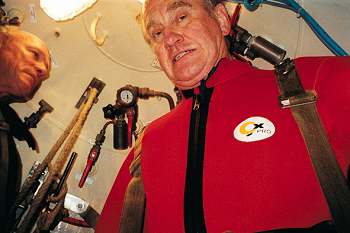
Despite the cramped conditions, I was expertly kitted up by Richard, one of the French instructors, and was able to leave the bell - and more importantly re-enter it - without difficulty. As I have said, the control panel was well laid out, and the dives I watched were expertly handled. I visited Marseilles during the first week of the sat course and hope to be able to return towards the end of a course. I hope also to be able to have the opportunity to dive with the surface-supply students in what I expect will be extremely clear visibility. Cooperation I have always believed that there should be the maximum cooperation between all diving schools, and I now look forward to discussing my experiences at the International Diving Schools Association meeting in America in May. INPP seems to run like clockwork, and foreigners like me are made extremely welcome. I can certainly recommend the school and, though I did not have breakfast to see if students are allowed more than one baguette, I could not fault the food I had both in and outside the school. It is always good to see things for oneself. I can now confirm that all the teaching for sat divers is in English, and that the courses are recognised by the HSE and IMCA. Under French Government rules, dive tickets are only issued for 10 years - something that, as I have said before, I support. But if the diver is able to prove that he or she has been diving regularly, renewal is automatic, with no further training required. |


© 2001 Underwater World Publications Ltd.