|
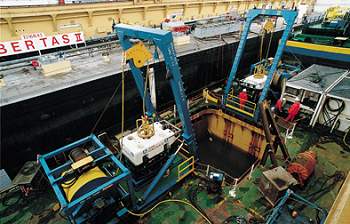 Smit Tak has won the contract to remove the highly toxic cargo of styrene, isopropyl alcohol (IPA) and methyl ethyl ketone (MEK), together with the intermediate fuel oil (IFL), from the wreck of the tanker Ievoli Sun, sunk off Alderney last October. 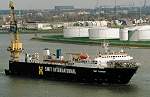 After leaving Fawley, near Southampton, and while off the French coast, the Ievoli Sun had suddenly taken on a dangerous list when sea water entered empty ballast tanks. A vain attempt was made to salvage the vessel by a French tug which towed the stricken vessel around the Cherbourg Peninsular, but the ship capsized and sank 10.5 miles north-west of Alderney.
The Ievoli Sun now lies on the seabed at an angle of 145 degrees, with a least depth of 65 metres over the wreck. Two of the empty ballast tanks have subsequently apparently imploded due to pressure differentials. The only remaining intact ballast tanks are the No. 9 tanks on port and starboard. The Smit Tak fixed-price proposal - the only one that did not include the use of divers - was based on a schedule of 36 days. Crawl 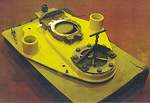 The Rotterdam-based company's novel approach was to use a "spider" to crawl over the hull to locate a convenient section which had no strengthening members immediately beneath. This location was marked with magnetic pins, and, from the surface support vessel Smit Pioneer, a hot-tapping system was then lowered, with a work-class ROV supervising the operation and providing help as necessary.
The hot-tapping unit first attached and sealed a plate to the outside of the hull at the selected location. The hot-tap was then made through a gate valve attached to the plate. This penetrated the outer hull. Next, a sleeve was passed through which sealed against the inner hull, or tank skin. The hot-tap then drilled through the second skin and accessed the cargo. Hot oil 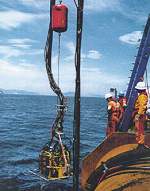 Holes were made at the top and bottom of the chemical tanks to enable the buoyant cargo to be displaced by seawater. The IFL was expected to be a little more troublesome to remove, as its viscosity was expected to be high at the ambient temperature of around 8°C. However, it was planned to introduce hot oil to overcome this hurdle.
The pumping operation is a joint venture with Framo pumps, who provided the pumping system. As Underwater Contractor went to press, it was reported that removal of the styrene had begun. The wreck and the salvage operation have raised some interesting legal queries. The principal problem has been deciding in whose waters the wreck lies. The British territorial limit is set at a fairly standard 12 miles, but the Channel Islands are autonomous states which set their own territorial limits. In the case of Alderney, this is 3 miles - so, at 10.5 miles, the wreck was originally outside Alderney's jurisdiction. However, the island's interest was aroused when residents began to smell something smelling suspiciously like styrene landing on their shores. Other delineation systems have been studied, including the Pollution Zone, Median Line and Continental Shelf, and lawyers are still busily working on the case. |

© 2001 Underwater World Publications Ltd.