|
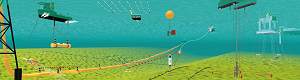 How has Sonardyne managed to grow so rapidly in the highly competitive international underwater instrumentation business? Underwater Contractor Editor John Bevan visited Sales Director Richard Binks at the company's Hampshire (UK) HQ to find out. The ascendancy of Sonardyne - one of the big success stories in the world of underwater acoustics and electronics - has been dramatic. Founded by John Partridge in 1970, the company has developed into a multi-million-pound concern, employing some 120 people at its Ocean House HQ alone. Located some 40 miles south-west of London, in Yately, Hampshire, the Ocean House building provides 34,000 sq ft of purpose-built office, research and production facilities. These include three large acoustic test tanks and a full ocean depth pressure-test facility. The considerable achievements of the company have attracted Royal acknowledgement with two distinguished Queen's Awards - one for Technical Achievement (1994), and one for Export (1999).
So what is it that Sonardyne does so well - enabling it to grow so rapidly in a competitive, international market-place? In my opinion, it is Sonardyne's unique ability to identify and evaluate what the industry needs, and what problems exist, then to tailor-make a reliable and cost-effective solution. Over the years, Sonardyne has methodically worked its way through every sector of offshore operations and successfully penetrated each market sector. Sonardyne equipment can be found in offshore oil and gas sectors including seismic exploration, drilling, construction and production. Related equipment has also spread into oceanographic and defence applications. Long baseline (LBL) navigation systems Sonardyne's initial 'bread-and-butter' product was its eminently successful Long BaseLine (LBL) system, seen today in the COMPATT range of products (COMPuting And Telemetering Transponders). Depending on the positioning accuracy and range required, COMPATTS are available in three frequency versions: Medium Frequency (16-36kHz) giving ranges of up to 3km and a relative positioning accuracy of +/-0.15m; Extra High Frequency (50-110kHz), giving ranges to 1km and a relative positioning accuracy of +/-0.05m; and Low Frequency (8-16kHz), which can range up to 10km. Sonardyne's latest COMPATT development is a transponder which can switch between EHF and MF modes, thus allowing operators to utilise the high accuracy benefits of EHF in deep water. Sonardyne LBL systems are found in use world-wide in such diverse applications as ROV tracking, spoolpiece metrology and installation, mineral exploration, salvage, DP position referencing, field monitoring and riser shape and angle monitoring. Depth ratings up to 6800m are currently provided.
Acoustic position referencing for dynamically positioned (DP) vessels is an important market area, especially given the offshore industry's focus on deep-water exploration and production. As an example, a Sonardyne Long and Ultra Short Baseline (LUSBL) system is being used to provide critical positioning information for the world's only fully DP floating production vessel, the Seillean, which is currently operating in 1800m water depth off Brazil. The company is also working on positioning vessels in 7000m water depth. ROV tracking Accurate deep-water ROV tracking has become a necessity for deep-water exploration and construction. Other requirements include the tracking of telecommunication cable ploughs and grapples.
Sonardyne's tracking system range also includes solutions for inshore operations. One such system is ROV-Trak, an entry level LBL system for divers and small ROVs. Homer-Pro and ROV-Homer are simple 'Range and Direction' acoustic systems which utilise low-cost transponders to mark seabed targets so that they can be quickly and easily relocated. Rapid relocation One of the more novel applications of Sonardyne's technology is the system they developed for British Nuclear Fuels Ltd (BNFL). Any BNFL vessels which transport irradiated nuclear fuel worldwide could, if disaster struck, end up on the seabed. To assist the rapid relocation and estimation of the configuration of any such vessel, Sonardyne provides four transponders to each vessel, connected to two Data Acquisition Units (DAUs). Data on location, roll, pitch, depth and cargo status can thus be obtained with relative ease by surface salvage vessels. Marine seismic One of Sonardyne's most successful ranges has been its SIPS (Seismic Integrated Positioning System) family of products, which enable marine seismic survey companies to know the precise position of their towed hydrophone arrays which can be anything up to 8km long and 20 streamers wide.
More recently, Sonardyne has used the experience gained in the deep marine seismic market to develop an acoustic positioning system for Transition Zone (TZ) and Ocean Bottom Cable (OBC) seismic operations. TZ/OBC operations use hydrophone/geophone cables laid statically on the seabed. When an area has been surveyed, the cable is picked up and relaid in an adjacent area. The Sonardyne system uses a multi-node network of low-cost transponders to derive more accurate hydrophone positions than can be obtained with conventional techniques. Drilling Drilling is another area where Sonardyne is pioneering new applications for underwater acoustics. In position-fixing applications, BOPNav has been developed to provide accurate guidance for BOP (Blow-Out Preventor) and riser connections in over 1000m water depths. BOPNav uses a stack-mounted transceiver working in conjunction with integrated Long and Ultra Short Baseline (LUSBL) systems. They have been used, for example, on the Noble Paul Wolff for drilling in the record depth of 8017ft, as well as on Petrobras's PXXIII and Transocean's Discoverer Seven Seas. Systems have also been developed for emergency BOP control. In the event of loss of primary electrical control to the BOP, the Sonardyne systems allow emergency shut-down and riser disconnect procedures to be executed. Due to the necessity of checking the integrity and profiles of ever-increasing riser lengths, Sonardyne has introduced the Marine Riser Angle Monitoring System (MRAMS). This cable-less solution uses a USBL system and BOP-mounted transponders fitted with high-resolution inclinometers. Defence applications The ingenuity of Sonardyne's problem-solving engineers was displayed to good effect in a recent project carried out for NATO. In this case, NATO was carrying out submarine detection trials in the Mediterranean using the Italian submarine Sauro. The detection equipment had been developed by the UK Defence Evaluation and Research Agency (DERA). Sonardyne's solution to the complex navigation and position-fixing demands of the trial was based around a MF frequency LBL system with APS3 tracking software, a remote transceiver designed for positioning mobile targets called Mini ROVNav, and a seabed navigation array of COMPATT transponders. Members of the oceanographic community use a variety of Sonardyne products and are particularly good customers for its range of acoustic release transponders. These vital items of kit have depth ratings to 6000m and enable oceanographic instrumentation strings to be reliably and economically recovered after long deployments. There are ties with academic institutions. The Hydrographic Surveying Department of Plymouth University enjoys particularly close cooperation with Sonardyne's training, research and development centre based at Turnchapel, near Plymouth. This is also the home port of Sonardyne's trials and training vessels Catlab, Rangemaster and Val B. Healthy links are also growing with the Southampton Oceanography Centre (SOC) which has installed a USBL system on its research vessel Charles Darwin. NuNav integrated software With so many different applications for its hardware, Sonardyne has found it essential to develop its own standardised software to permit seamless integration of its various systems. The result is the NuNav range of software packages, described as a combination of generic building blocks that can be combined to generate a family of different software applications. NuNav products so far include Pharos Lite, the entry level for tracking and navigation of a single subsea vehicle; Pharos Survey for up to two vehicles and up to fourteen beacons in an array; and Pharos Construction, which is the top-level navigation system for large offshore construction and field development projects. Pharos Construction can handle multiple vehicle tracking with fieldwide transponder arrays. An important feature of NuNav is its ability to interface with client systems to ensure user-friendliness. My overall impression of Sonardyne was of a highly professional, highly technical, design and manufacturing company. An intimate front-end involvement in underwater navigation and position-fixing provides the company with a real-world understanding of the problems and demands of the international offshore industry. It exploits this knowledge to develop cost-effective, customised solutions across the entire spectrum of underwater operations. In addition to its commitment to close customer relations, I was struck by Sonardyne's dynamic and often lateral-thinking approach to problem-solving and its emphasis on cost-effectiveness. The workforce is highly motivated and takes a real pride in the company's successes and the approbation of clients. |


© 2000 Underwater World Publications Ltd.