|
 Subsea cable specialist Global Marine believes that maximising research and development opportunities can pay dividends. UCI editor John Bevan visited the company to find out more. At Global Marine Systems' extensive training, testing and development site at Boreham, near Chelmsford, UK, James Ramshaw, Director of Technical Development, gave me a run-down on the company's current activities. "While there has been a drop in the demand for the traditional cable-laying services, Global Marine has not only sustained its investment in R&D but has actually increased it," he explained. "This is because we intend to be in a position of strength when the cable market eventually recovers as well as ensuring that we remain in the forefront of the cable maintenance and repair business. We are constantly improving the techniques involved in finding the cable, recovering it and re-jointing it. "Deep Grab is one of our latest innovations, and we are about to deploy a brand new, patented, cable recovery grapple which 'flies' along, beneath the seabed, to pick up buried cable." James Ramshaw described how Global Marine had a three-pronged approach to R&D. First, Global Marine maintains close liaison with universities. "We enjoy particularly close relations with Cranfield University on subjects of marine technology and soil mechanics. Feedback "Second, we actively exploit our fleet experience, maximising the feedback from our experienced fleet personnel. Third, we have a pro-active in-house R&D department with its dedicated team of engineers headed by Phil Hart. When these three prongs are brought to bear, we have a very powerful and effective team to develop industry leading technology." Next, Murray Eldridge, Director of Customer Services, gave me a privileged insight into the subsea cable business. There had been many changes in a very short period of time, so I asked why it was that such a large business sector had got so little exposure. "This was probably due to the fact that before subsea cables suddenly expanded, the post, telecoms and telegraph (PTT) industry had already become firmly established, with major state-owned monopolies set up around the world," explained Murray. "So when the explosion in subsea cables happened, the infrastructure already existed to meet the demand. The companies simply tooled up for the new task and went ahead with it. No fuss." The customer use of cable is also still evolving rapidly. "About ten years ago, a high percentage of the traffic was voice communication. By 1995 the use of cable for data transmission increased rapidly, and by the year 2000 the cables were carrying 50:50 voice and data. We estimate that by 2004 - 2005, voice traffic will drop to only 5%." Security
"Our test facilities handle electrical voltages of tens of thousands of volts, hydrostatic pressures equivalent to ocean depths, cable tensions of more than 100 tons, and cable bending under tension. We are an Authorised Lloyds Testing House". This was certainly not a place for idle sightseers. It seemed that the main activity at the training centre during my visit was in the application of the universal joint and the universal quick joint. Up to 30 trainees could be accommodated at any one time, with courses starting at about 3 weeks' duration. Stewart was clearly a professional trainer as well as a highly competent engineer. He introduced me to the art of offshore cable deployment and testing in an easy-to-follow, logical sequence. At each stage, he pointed out the relevant testing system. The nature of the requirements is such that these facilities were spread over several acres. The first demand on a cable while it is being deployed is tension. This causes a very slight tendency for the cable to twist (because of the coiled armoured wire coating) and stretch. The design of the cable therefore has to ensure that these forces are not transmitted to the delicate optical fibres in the core. Naturally, rigorous testing is essential to ensure that the design and manufacturing processes have achieved the desired results. To do this, 10-metre lengths of cable are cycled through a series of test pulls of up to 100 tons in a special tank while the integrity of the fibre optics is checked. The same tension facility is used to test the synthetic ropes which are used in handling the cables. The next demand on the cable (and any connectors etc) is the bending as it rolls over the bow of the cable-laying vessel. A bend test is therefore carried out in a specially enclosed, secure yard, laid out with the appropriate winches, cable tensioner and 2-metre and 3-metre diameter pulley-wheels.
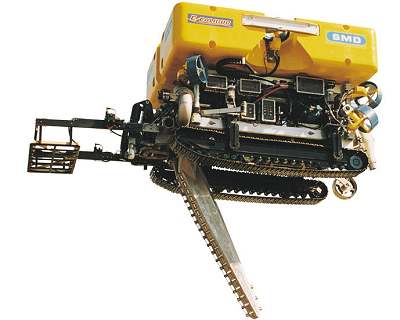
Finally, some of the long, ocean-crossing cables have electrical conductors for powering repeaters (optical amplifiers) at various points along their length. These conductors carry a low amperage (about one amp) but a high voltage (up to 10 kV). So the final test facility is an electrical work bench sealed in a strong steel chamber inside which high voltage tests are carried out on cable samples. Stewart Ash introduced me to Phil Hart, General Manager for R&D, who kindly showed me around his latest development - Deep Grab. I mean he literally "showed me around", because Deep Grab - a bolt-on cable recovery tool for a large work-class ROV - is a seriously big beast. Water jets In essence, Deep Grab is a hook (to catch the cable) on the end of a hydraulically extended arm measuring 3 metres in length. This arm is driven into the seabed with the assistance of downward and forward-facing high pressure water jets. When deployed, the water jets excavate ahead and the ROV can move forward until the cable is captured. The distance it has to travel through the seabed to catch the cable is quite short because Deep Grab can be deployed just a metre or so away from the cable. This is especially important when there may be other cables nearby. Furthermore, disturbance of the seabed is minimal so environmentalists can rest easy. Once the cable is caught, the entire arm (with its captured cable) is detached from the ROV, and a heavy-duty rope connected to the arm is used to bring the cable to the surface. Two Deep Grab units are already in the field in the Far East, onboard the Wave Mercury in the Yokohama zone. |




© 2002 Underwater World Publications Ltd.