|
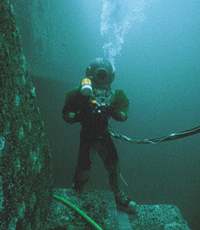
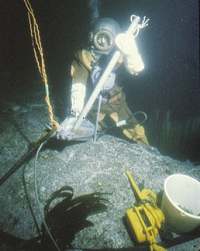
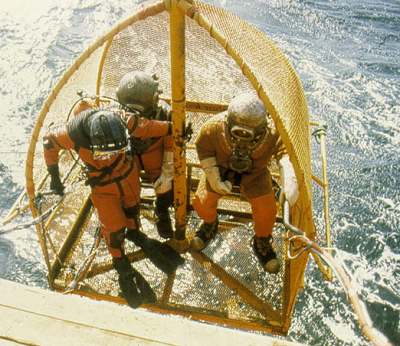 Continuing my visits to diver training establishments around the world, I recently spent three days in Norway at Statens Dykkerskole, the Norwegian State Diving School, at the invitation of Rune Ingebrigtsen, writes Michael Cocks. I had met Rune at meetings of the International Diving Schools Association (IDSA) and had heard from the likes of Jim Sheppard of TWI North how excellent the facilities at the Bergen-based school are. I was not disappointed and in two ways was greatly surprised. The school has been on the present site for just over ten years in its own purpose-built building, with excellent changing facilities and two saunas. An advantage is that there is deep water of more than 100 metres very close to the land. The school has a well-equipped barge from which I dived and a smaller boat. There is a large steel structure on the sea bed, obtained from the North Sea, on which students can carry out inspection work. The course lasts for 14 weeks and here I discovered my first surprise - it costs only a little over £800 sterling and, although Norway is not in the European Union, any EU resident can attend at the same cost. English-speaking The only snag at present is that the teaching is in Norwegian. But the nine instructors - all but one experienced saturation divers - speak excellent English, and it is possible that if at least six English-speaking students wanted to do the course together it could be carried out in English. Potential students should, however, know that there is an additional cost for accommodation of around £2000, and the price of beer in Norway is double that in Britain. There is only a small scuba element in the 14 weeks' training, and this comes after some surface-supply training. Most of the students are qualified scuba divers. Diving time, as in France, seems longer than in the UK, with at least two dives lasting for three hours. The equipment which I saw and used was excellent, and each student is allocated his own Viking drysuit for the duration of the course. The other surprise for me was to find that the school runs a 16-week course for the more experienced diver in the use of Siebe Gorman standard diving equipment. Terminals
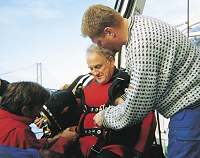
The course is divided into three sections: construction work, pipeline laying and finally salvage, which includes airlifting and recovery of a vessel from the seabed. Here, as with the air diving course, each student has his own dedicated diving equipment - no mean feat with standard gear now being so expensive. The price of the course is also a bargain, being similar to that for the air diving students at under £1000. I used the standard gear in one of the two excellent indoor tanks and was able, slowly, to get myself comfortable. I have now "invited" myself to join the next standard-gear course in the spring as I want to see how the students cope with the much heavier gear. It would be comparatively easy, I am told, for this course to be conducted in English. As a keen member of the Historical Diving Society, I am delighted that the tradition of using Siebe Gorman gear is being continued. I believe that the Health and Safety Executive were too quick to ban its use in the UK because it did not have a reserve of air supply. In fact, there is enough residual air in the suit for most emergencies and an alternative umbilical can be fitted under water very quickly. Family I have always found it easy to sense whether the students are happy with their training. Here, it seemed that all were part of a large family and thoroughly enjoying the impressive facilities. I was particularly pleased to find that, as with the UK's Royal Engineers, the instructors, especially at the start of a course, dive to observe the students and are prepared to fail those who do not make the grade. In addition to its air diving courses, the Bergen school is hoping to restart saturation training on its barge - encouraged by the Norwegian oil companies. It also runs a total of 20 specialist courses, such as chamber supervision, first aid and supervisor qualification. I also paid a visit to the Norwegian naval diving school, where I saw its impressive 20-metre submarine escape tank, and to the Norwegian Underwater Intervention Centre, where divers were conducting a simulated 350-metre dive to practise work on a deep pipeline. This centre is financed by the Norwegian oil companies, and all in all the Norwegian government and industry take a keener interest in training standards than in the UK. In addition, I was able to talk to the secretary of the Norwegain onshore diving contractors association, Arne-Johan Arntzen, and was pleased to learn that the pay for the divers they employ is a lot higher than in Britain. As someone who had a Danish great-grandfather, I always feel at home in Scandinavia, and on this trip could not have found the local people more welcoming. Sub-standard As I have said, the British diver can learn a lot from overseas trips. But I believe it was a mistake for the HSE to approve a huge raft of overseas diver training companies without inspecting them first. There were in fact two sub-standard schools in South Africa, now effectively closed, but there are also many that surpass the training standards in the UK. Through meetings, such as those of the International Diving Schools Association, more divers from different countries are getting together to swap ideas and to try to achieve common training standards. I hope that our two British schools will attend the next IDSA meeting in Canada next May. It is in order to advance this progress that I will be visiting more overseas schools in the months ahead. |




© 2002 Underwater World Publications Ltd.