|
 Even the toughest diver can feel daunted by the idea of working around submarines, says Millis Keegan, who reports here on a major rescue training exercise involving the British and Swedish navies Serving on a submarine crew is not for everyone. Even the toughest diver can get the chills when visiting a submarine, even though it seems quite harmless at the dock. It does not take much to imagine being locked up in such quarters a couple of thousand feet down below, day after day, week after week without seeing land or daylight. The only thing you actually will see are the same faces around you every day, the walls of the sub, and the same old video tapes that you have seen over and over again. You have to be able to cope. Period. It is for these men that the navy keeps an operative submarine rescue service. They need to know that somebody will come looking for them if somethings goes wrong. Other good reasons are incident investigation, search and salvage and weapon recovery. Many nations own submarine rescue assets, but in real life a submarine rescue operation will probably involve more than one nation. For that reason, some of the most experienced crews in submarine search and rescue meet every third year in a Nato exercise called Sorbet Royal. The exercise is also open for PFP (Partnership for Peace) countries. The goal is to develop common procedures and understanding between the participants. Vehicles
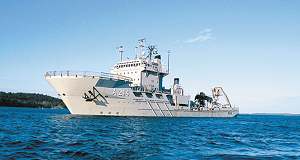
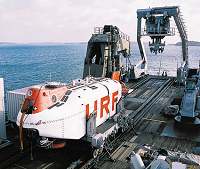
Britain has the LR5, a small submersible that is constructed to mate to a disabled sub up to an angle of 60 degrees. It can reach a depth of 400 metres, pick up 15 crew members and carry them under pressure. Sweden has the URF (the name is a swedish abbreviation of Submarine Rescue Vehicle). URF can operate down to 450 metres, she can take up to 35 rescuees and transport them safely under pressure, but can only work at an angle of 45 degrees. However, she can be flown in and towed at a speed of 10 knots from the nearest harbour to the accident site, which can be vital for the lives of the crew. The British LR5 cannot be towed. She is dependent on a mother ship to function fully. The Swedish navy ship Belos is the mothership of URF, and, thanks to a few modifications, she can also operate as the mothership of the LR5. The LR5 itself does not have her own mother ship. In case of an incident/accident or even an exercise, a suitable ship is rented - a so-called "Vessel Of Opportunity" (VOO). Capacity Belos is a very interesting ship, designed to fit the needs of Swedish navy submarines. She has the capacity to handle major rescue missions. Along with the URF, the diving centre aboard includes search equipment and remote operated vehicles, as well as all necessary dive equipment and divers. Also aboard is a large recompression system, including three chambers that can handle decompression of up to 35 people, which happens to be a full Swedish submarine crew. Belos also carries all necessary support functions, like food, medical equipment, communications, and a helicopter platform. Britain and Sweden conduct submarine rescue exercises together at least every second year. Usually the LR5 is taken aboard Belos. During the exercise a Swedish or a third-nation submarine is used. The reason for this is that Britain's submarine fleet consists only of nuclear submarines, and lying still pretending to be a stricken sub is not very safe for a nuclear subs' cooling system. Britain is a global submarine operating nation. It has to be able to handle a rescue operation anywhere in the world. Mobility is the key word. Its submarine rescue assets have to be able to be flown anywhere in the world and be set up and operative as quickly as possible. This puts a lot of pressure on the logistics of a rescue operation, so all equipment is made to fit in containers for easy transport. For example, in order to launch and recover the 25-ton LR5 in and out of the water, a portable A-frame can be welded on any VOO ship. The biggest challenge is to find the disabled submarine (dissub). Once found, the rest is more or less routine; but it does not become routine without extensive training. Search exercises are held, using a towed-array sonar or a hull-operated sonar. When there is an interesting sonar return, the ROV is sent down for confirmation. If a submarine cannot wait for help and the crew must abandon the vessel, they could be spread over a large area on the surface. This has to be trained for as well: how to find them, get them out of the water, provide medical treatment, and so on. Pod-posting Once found, a disabled submarine might need supplies while waiting for the rescue vehicle, so "Pod-posting" is trained. This means taking supplies down in metal cannisters using an ROV and/or divers and getting them into the submarine via the escape hatch. Also taught is "ventilating" the submarine - connecting hoses to ensure that the crew aboard gets fresh air while waiting for the rescue mini-subs. When the rescue vehicle is ready to be launched, an actual rescue of a submarine crew takes place, faking injured crew members and other difficulties. LR5 docks to the sub's hatch with a mating skirt, the water is pressed out, and the hatch can open for the submarine crew to climb over. LR5 then starts a cycle of personnel transfers. She can evacuate up to 15 personnel at a time to a surface support vessel or a mother submarine. LR5 can make up to eight return trips to the dissub before recharging batteries. Commander Fredrik Hallström, commanding officer of Belos, tells me that the first steps toward a cooperation were taken in 1989, but it was not until 1996 during the Sorbet Royal exercise in northern Norway that it really started. The two rescue vehicles LR5 and URF were exercising side by side and the two countries found a lot of common ground. "Even though there are different operational parameters to consider between the countries, we have found that we can complement each other," Fredrik Hallström says. "All rescue operations are a battle against time. Speed and safety are essential for a successful rescue of a submarine crew." In a real situation, both systems are activated and taken to the place of the accident as quickly as possible. Normally the systems would be in place within three days. Depending on the situation, a decision is made either for both mini-subs to be involved in the rescue or for one to stay behind as back-up if the first operation fails. Survival
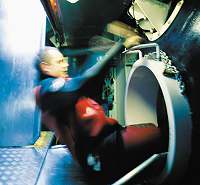
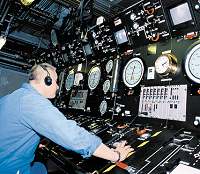
To keep a top-notch operative rescue service costs a lot of money, and the agreement states that each country will cover its own costs during exercises. In case of a real accident, the nation with the sunken vessel pays. After my interview with the Commander I am guided around the ship. Since we are way out at sea and I have some hours to spend aboard this interesting ship, I choose to hang out with the divers, being a diver myself. They are busy conducting an exercise they call "Surface Decompression Diving with Oxygen". The exercise is about getting the divers under pressure as quickly as possible to help shorten their decompression time. It was interesting to see the well-trained dive crew work against the clock. Time is measured from when the divers break the surface until they are in the chamber recompressed to a depth of 12 metres. The goal is to make it within four minutes. The divers suit up. The hatch under the diving bell is removed, and both divers are cleared to enter the bell. Warm water As it is lowered into the sea, the warm water to the suits is turned on. All the orders are given by the dive supervisor who follows the procedure via a monitor in the control room. After a few minutes the dive is aborted. The divers are on their way up. The bell breaks the surface and the race is on. The divers are quickly helped out of their suits and rushed to a slide that takes them directly down below to the chamber deck. They are determined to finish within the time limit and they do it with time to spare. The clock stops when the chamber gauge shows 12 metres. It has taken 2 minutes and 45 seconds. BELOS FACTFILE Belos is 105 metres long and 18 metres across. The displacement is 5300 tons, cruising speed 11.5 knots. Equipped with five cranes and an A-frame with a total lifting capacity of more than 160 tons, Belos is used as a mothership for the Swedish Navy's submarine rescue vehicle, the minisub URF. The URF weighs 55 tons and can easily be launched and recovered from Belos. The submarine rescue vehicle URF (or the LR5) is then placed on a track to an airlock that leads directly into the chambers. The airbank holds 14,400 cubic metres of gas. LR5 FACTFILE Britain's submarine rescue service is operated by Rumic Ltd. Their main assets consist of the LR5, a Scorpio 45 RO, a Dissub Depressurisation System (DSDS), a navigation tracking outfit, and a portable handling system. The full system includes transfer under pressure. The primary role of the LR5 is to provide a rapid reaction rescue in North European waters, and also to complement the US in a larger rescue scenario. Weight is 21.5 tons. Maximum operating depth is 400 metres. |



© 2003 Underwater World Publications Ltd.