|
 The ten-month Underwater Skills Program at Canada's Seneca College of Applied Arts and Technology offers students a broad range of commercial diving tuition, often in challenging conditions. Michael Cocks reports In May last year, over dinner at the International Diving Schools annual meeting in Marseilles, I mentioned to Dave Geddes of Seneca College, Ontario, that I had never had the opportunity to dive under ice. Eight months later, at the end of January, I found myself in Canada during one of the coldest winters for ten years surrounded by plenty of frozen water. The Underwater Skills Program was established at the Seneca College of Applied Arts & Technology almost thirty years ago, and I was pleased to be able to meet Bob Landry, now with the Canadian Ministry of Labour, who was one of those who set it up. The program is part of the college curriculum and, as well as diving during the ten-month course, students have to do a certain amount of non-diving study. The course costs Canadians $2400 and foreign students about $10,000 (£4000), but trainees have to pay for all their own equipment, except for cylinders and helmets, plus accommodation and books. Nevertheless, this is still good value, as I estimate that the students get well over double the required 50 hours (on surface demand) in the water. Rigorous
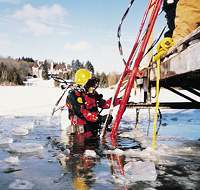
Training takes place mainly from a barge in a shallow lake in the extensive college grounds. But there is also a heated swimming-pool with what I can best describe as a shaft in it. This enables students to dive to 40 feet in controlled and comfortable conditions, where they can familiarise themselves with the helmets. As the year proceeds, so diving increases. While I was there students were diving twice a week and attending lectures and chamber classes at other times. I sat in on a number of these and particularly enjoyed the talk given by Wayne McPherson of the Ontario police on the problems of diving under ice. When the time came for me to sample the experience in the college lake, I saw for myself that the entry hole is made triangular, rather than round, for easy access. Also, that water near the barge is kept free of ice by an air bubbler. Nevertheless, once under water I still managed to bang my head a number of times on the ice as I finned around (although luckily I was wearing one of the college's excellent "27" Superlite helmets). I had a total of three dives with Seneca. The last was a lesson in welding by Mike van den Oetalaar using both Thyyssen and the British Hydroweld rods. Moon pool At any one time there can be at least twelve divers in the water, with an additional student fully kitted up as standby diver. While I was on the barge divers were carrying out several different tasks. Two were diving out of the moon pool attempting to cut a length of pipe with a hack-saw. Two others were surveying a salvage project measuring 12ft by 6ft, which later they had to make watertight and float to the surface. And four divers were constructing a penned area in the water using heavy piles and wood. My longest dive lasted 77 minutes, but some of the students spent more than three hours on a task. The facilities at the college are excellent, as are the instructors who include Wayne Churcher of the police marine unit and Mike Borean who is skilled at making certain everything works. Dave Geddes shares the work-load with John Walley, whom I had met at the International Diving Schools meeting in Panama City. Both are highly experienced commercial divers who still dive with the students. So here is another school which meets the criteria I set out in the last issue in my article on South African schools. The students are continually being marked on their in-water skills and must achieve a mark of at least 55 per cent to stay on the course. They have to learn to work as a team and to perform a number of difficult tasks under water. As is usually the case when I meet foreign students, I was made very welcome, especially by the one who said that his grandfather was the same age as me. They willingly lent me some of their kit so I could dive, and we worked well together. I look forward to diving with them again, as I have "invited" myself back after the IDSA conference at Seneca College at the end of May. I hope to be allowed to do some 50ft dives in a deeper lake from the newly acquired Cato II boat, and to go to Wiarton, a town in Georgian Bay off Lake Huron, to do some 50-metre wet bell dives. This was my thirteenth visit to an overseas commercial diving school. Seneca's courses are run by commercial divers who are genuinely keen to see that their students reach a high standard. Divers spend a considerable time in the water and are given worthwhile tasks to perform. At Seneca there is an advisory board on which representatives of local diving companies sit, and students spend a week during their course at a commercial dive company. Foreign The Canadian Government is about to introduce a competency assessment regime, which means that divers trained overseas or before a certain date will have to be re-assessed. This is something I welcome, as it will make certain that foreign divers are familiar with Canadian diving practices. Divers will also have to prove that they have dived within the last two years to be allowed to continue; again a sensible rule. I am sure that this will be raised at the IDSA meeting at Seneca in May. DDRC of Plymouth, IMCA, Hydroweld and Interdive are among the British members. Unlike the early days, when some of the less safe onshore diving companies were unwilling to let me visit or dive with them, almost all overseas commercial diving schools now seem to welcome me and are keen to show off their facilities. Credit I am not in the business of grading the schools. All have to meet local needs. What I want to see are well-trained and safe divers who bring credit to the schools that train them. I have been fortunate in the last 12 months to have visited first-class training establishments in South Africa, France, Holland and Norway. All have met my fairly stringent personal standards, and I am that certain divers trained with them are among the best in the world. |





© 2003 Underwater World Publications Ltd.