|
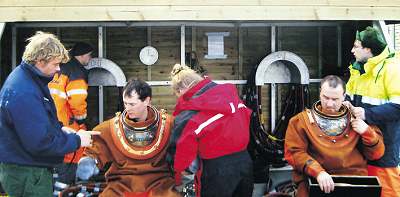 The Norwegian State Diving School's 16-week Construction course gives students training in standard-hat diving. Michael Cocks tries out a form of diving he is sad to have seen consigned to the history books in the UK In April I returned to the Norwegian State Diving School in Bergen, and enjoyed perfect weather for five days. The main purpose of this, my second visit, was to take part in the school's 16-week Construction Course, which includes standard-hat diving. The eight students on the Construction course, of whom one was Swedish and one a woman diver, were about half way through. After some trial dives in the pool, and some shallow-water dives to help them learn how to control their buoyancy wearing the standard-hat gear, they were now engaged on a real work task, namely extending a jetty.
When I tried to do some drilling and air-lifting I found it hard work to get my position just right and the correct buoyancy in the suit. The technique for controlling air in the suit, by pressing the purge button in the helmet to expel air, is slightly different to the method I had previously used with the Historical Diving Society, so I had a few problems on my first dive. Ladder The next day I felt much more comfortable and easily got up the excellently designed ladder. I particularly appreciated the dry gloves, which were sealed onto the suit by means of a ring device. Although four fingers were in a mitt, with only the thumb free, I found it comparatively easy to work with the gloves and they certainly kept my hands much warmer. After completing the concreting work, the students move on for three weeks of pipe laying, then finish off with an extensive salvage job. Towards the end of the course, students undertake two 40-metre and two 50-metre dives, two down a shotline and two in a cage. They have to prove that they can be dekitted and into a chamber from a depth of 12 metres within four-and-a-half minutes. Demand for this course is high, and divers have only about a one-in-three chance of getting on it. All are likely to find work, as standard gear is widely used in Norway. Arne-Johan Arntzen, the Secretary of the Norwegian Society of Underwater Contractors, told me that he had recently won a battle for standard gear to be used on a job by proving that the diver had at least five minutes of air left in the suit if the main supply failed. Bail-out I believe that the HSE in the UK was too quick to ban the use of standard gear. They tell me that, as well as the lack of a bail-out, they were worried about the effect of the noise on hearing. However, the highly experienced Norwegian State Diving School instructor, Finn Hansen, who has been diving for well over 20 years and who told me that 80 per cent of his dives had been in standard gear, seemed perfectly able to hear what I said to him at my usual rapid speed. Finn Hansen took me to visit an actual dive site - a Statoil terminal at Mongstad, where I was able to see a standard-hat diver working for Sjoeerntreprenoeren, which is 90 per cent owned by the construction company NCC. The highly experienced diver spent four hours in the water - guiding a drilling machine and filling the holes with explosives. He then had to spend more than 30 minutes in a decompression chamber. I admired the ease with which he moved, and the state he was in when he left the water - even ready to pose with me in modern gear for a photograph. Swedish It is clear talking to the construction company that standard gear will go on being used in Norway for some time to come. I am told by the school that they intend to train some of the Swedish school's diving instructors in its use, and are also likely to begin a shorter course for highly experienced air divers. I hope very much that the UK's Historical Diving Society will take up the invitation to visit the school to see standard gear being used in the "real world". The timing of my visit to the Norwegian State Diving School was excellent, as Norway's ministry of education has informed the school that funds to restart saturation training will soon be made available. In addition, four oil companies, Statoil, Hydro, BP, and Shell, have agreed to put up 13.3 million Norwegian kroner (more than £1million) to help support this training. Theory
I am certain that the sat training will be of the same high standard as the other training at the school. One great advantage is that they have non-tidal deep water right on their doorstep. It is also clear that director Rune Ingebrigtsen has been working extremely hard to develop the school, and I hope that its students realise how lucky they are to train there. Not only is the training excellent, but it is also remarkably cheap, with air diving courses costing a little over £1000. It would be good to see the UK oil industry and government taking such a keen interest in commercial diver training. The school is also now debating whether it will do a shorter, 10-week, surface-supply course for foreign EEC students, which should enable them to get an HSE-approved ticket. |




© 2003 Underwater World Publications Ltd.