|
 UCI Editor John Bevan spends the day with the Port of London Authority diving team and discovers what goes on behind the scenes in keeping the River Thames safe for navigation - and that even Tilbury Docks can look picturesque in the sunshine I had previously met the Port of London Authority (PLA) diving team at various events on the River Thames and had got to know some of its divers, so it seemed timely that I should give the team's Gravesend headquarters a visit to check out its operation. My visit turned out to be a privileged insight into how a highly professional diving operation is run. The PLA diving team look after the river bed of the Thames from Richmond Lock to Margate, a distance of 95 miles as the sea-gull flies. This covers an area of about 400 square miles. It is the team's job to keep the river safe for navigation, 24 hours a day, 365 days of the year. Responsibility It is hard to grasp the enormity of the spread of the diving team's responsibility. It maintains 305 mooring buoys and 14 tide gauges, repairs and maintains lock gates and sluices, salvages sunken vessels, frees-up fouled propellers and recovers cars and lorries with monotonous regularity. As the survey services keep improving their ability to detect anomalies on the river bed, the diving services have to follow up with an increasing number of site investigations and clearance operations. How significant is all of this? PLA Chairman, Simon Sherrard, answers this question with an air of boastfulness: "Against a background of difficult economic conditions in 2002, the volume of trade in the Port of London showed an increase on the previous year to more than 51 million tonnes." This increase has been supported by the addition of 26 new wharves along the river, below the Thames Barrier, to the list to be safeguarded for future cargo handling use, making an overall total of 52. On top of this, the PLA also looks after the Thames all the way upstream from the Barrier to Richmond Lock. Burden
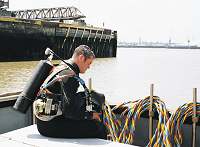
The two full-time divers are Kevin Leadbetter (Diving Supervisor) and Peter Semple, both ex-Royal Engineers, who report to Captain Geoff Buckby (Marine Services Officer) and Captain Peter Steen (Marine Services Manager). As luck would have it, on the day that I called in, the sun was out and it was an idyllic day to chug up and down the river between diving tasks. Today, the main objective was a routine inspection of the lock gates and sills at the entrance to Tilbury Docks. I arrived at the team's yard at Denton Wharf at midday. Kevin met me and gave me the "grand tour" of the yard. I was immediately impressed by the dive-training tank. It was an old, riveted mooring buoy turned on its end, which gave a 15-foot deep, 8-foot diameter cylinder. The operation was perfectly self-contained. There were diving stores, a therapeutic recompression chamber (available for hire by commercial diving companies), compressors, a rigging shop, a workshop, offices and showers, as well as the salvage plant and all the accessories of a navigational plant and equipment. Everything was arranged with military care and precision. The PLA has its own wharf and hard landing with berthing facilities for its salvage craft, dive boat and many other associated vessels, together with the necessary cranes and boat hoists. The PLA has been located here for the past 12 years, having moved from its earlier base in Tilbury Docks. Coincidence By coincidence, my visit happened on the same day that the diving equipment was being given one of its regular inspections by Divex diving engineer Richard Bird. Unfortunately, Richard - who is well known in the industry for his technical knowledge of diving equipment - was up to his elbows in helmets, umbilicals, test gauges and comms sets and was too busy to chat. I had also only narrowly missed a full audit of all the diving equipment by Roger O'Kane. This all told me that the PLA took the proper maintenance of its diving plant and equipment extremely seriously. I then joined the four-man dive team on board PLA Diver, a "Blythe 33" fibreglass catamaran powered by twin Volvo Penta inboard diesels providing 240hp with a maximum speed of 24 knots. Conspicuously placed in the wheel-house was a SeaPro 2000 SatNav system. As we cruised upstream towards Tilbury, I was fascinated by the way the large scale Admiralty chart scrolled by on the monitor, with the vessel's location pin-pointed on the chart together with its heading. We chugged into the open lock of Tilbury Dock and tied up to the open, outer, western gate. The water was up to the 31-foot mark carved into the granite block wall. We were on low water slack. Sweated Diver Glen Luxton was dressed-in and after his checks he slipped over the side into the brown water. Peter Semple tended his umbilical while stand-by diver Jason Durkin sweated it out in the mid-summer sunshine. Regular bursts of verbal condition reports came back over the comms from Glen as he felt his way down the hinge of the lock gate. Once at the bottom he set off across the sill to the other side, again feeling for damage and debris. About half way across he literally bumped into a gas cylinder leaning against the sill. It had been crushed flat against the sill by the gate. Glen finished his sill run and came up to the surface on the opposite gate, reporting all the way. That was the end of the inspection but he still had to recover the cylinder on his way back. This he did by dragging it back until he was under the boat and then attaching a rope, sent from the surface attached to his umbilical. After Glen had been recovered into the boat, the cylinder was hauled up. Splits in the side of the cylinder suggested that it had probably exploded when it had been crushed. At least there was no longer any potential problem with retained high pressure gas. We then moved up to the second set of gates and repeated the procedure. Plastic This time Glen found a section of plastic fender, probably knocked off the dock side by a passing ship. Judging by the effort needed to haul it up, it looked like it weighed about 100kg. Both items of debris were logged, photographed and handed over to the dock officials. Apparently the gas cylinder was a "first". That was all the diving work for the day. On the way back to Gravesend we passed Tilbury Fort. It was just off here that the Royal Engineers had carried out their very first helmet dive back in 1838. They cleared two wrecks from the middle of the river using gunpowder. Unfortunately they paid for their inexperience at the time with the life of one of their Sappers, Corporal William Mitchell, who became fouled in one of the wrecks when the tide began to run. Mitchell now holds the dubious honour of being the first ever military helmet diving death. We also passed the two purpose-built PLA salvage vessels, both 120 feet long and capable of lifting 120 tonnes over the bow. By the time we arrived back alongside at Gravesend all the diving kit had been squared away and the team was preparing for the next phase of the working day - the paperwork, or more precisely, the computer data handling. It was time to make myself scarce. |






© 2003 Underwater World Publications Ltd.