Could Divex supply electrically-heated diving suits, the mystery caller asked?
Indeed they could ! At this point the call sounded like a normal routine enquiry.
But then the conversation took a rather bizarre turn. The suits, the caller went on to
explain, were to ward off hypothermia during a night in a cement mixer! Not, it
transpired, part of some eccentric Guinness Book of Records stunt, but for a covert
surveillance operation !
It's not every day that the people at Divex receive calls as unusual as this, but
it does illustrate that no matter what the request they will focus all their skills
and resources on meeting the customer's requirements.
Following its merger with UWI Circle last summer, Divex is now firmly established as
one of the world's leading manufacturers and suppliers of commercial diving
technology.
"The merger was a strategic move aimed at developing our portfolio of products
and services," explains Managing Director, Derek Clarke. "It means our customers
can now call on a comprehensive, total capability in diving equipment, engineering,
technical support and specialist services."
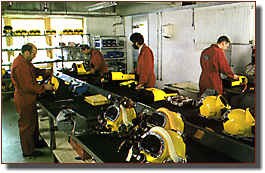
Helmet refurbishing in the Divex Workshop
It also means that the strongest heritage in the underwater business has been brought
together under one roof. Names like Seaforth Kinergetics, Gas Services, Swift Marine, Sub
Sea Services, Submarine Products, UWI, Circle Offshore, Dive Dynamics and Mara Engineering
have come together in Divex.
But what was the process that resulted in this unique pedigree?
"Such is the dynamic nature of the diving business, that the companies which
serve it have had to adapt with the market," Derek points out. "Last year's
merger of Divex and UWI Circle was the ultimate stage of that process."
For Divex clients there are considerable benefits in the expanded group, with an even
more comprehensive, total capability and a wider range of products and services in tune
with their clients' needs. The unrivalled range and depth of expertise and experience
within Divex is at their disposal.
Adding to the good news is the company's commitment to ensure that the economies
of scale will be reflected in highly-competitive pricing.
"One of the key strengths is the fact that we now have a stronger, firmer base on
which we can expand the Divex business world-wide," Derek Clarke concludes.
"This will help us to achieve our aim, which is, quite simply, to be the first choice
of international operators for products, support services and technology."
Offering a comprehensive capability
Divex is based on a purpose-built headquarters complex on the western outskirts of
Aberdeen, in Scotland, where design, production, service and marketing are all brought
together under one roof.
The location also means that Divex is at the very heart of developments in one of the
most demanding underwater markets in the world the North Sea.
The Alton base in Hampshire where UWI Circle had its recreational diving division
is being developed and expanded to create a southern operations base for the full range
of Divex services, supporting important commercial and defence-related contracts in
England.
In addition Mara Engineering's fabrication facility at Kidderminster, in the
Midlands, is in the course of being integrated into the Divex company. This office, headed
by Peter Williamson, Underwater Systems Engineering Manager, adds design and manufacture
capabilities to the company. Hyperbaric systems, pressure vessels, subsea tooling packages
and bespoke engineering projects are all catered for here.
Based at premises on the Kirkhill Industrial Estate, beside Aberdeen Airport, sister
company Circle Technical Services serves the underwater and offshore maintenance and
construction industry. In an effort to meet changing market trends and specific customers
needs, Circle Technical Services offer integrated engineered solutions. Equipment and
trained operators are provided on a contract basis. Specialised services available
include, SNARK jetpump dredging system, INDEPTH grit entrained cleaning system, IEV marine
growth management system, JETCUT water abrasive cutting system and HYDROMARINE friction
stud welding.
"Divex can now provide a much wider portfolio to our customers," David Dent,
Divex Marketing Director points out, "with a consistent and more cost-effective
supply."
The message he is keen to put across is that there is more reason than ever to work
with Divex.
"When clients speak to us they are speaking to people who have the experience and
knowledge to provide a solution that is precisely targeted to their needs," David
continues. "Using that ability, we want to develop a partnership-style relationship
with our key clients, working with them to develop their business."
This innovative approach is well illustrated by a look back through some of the more
unusual past projects.
This ranges from the fitting out of a tourist submarine destined for the Virgin Isles
through to the Thames Barrier project.
To enable condition monitoring transducers to be installed in the main bearings of the
barrier's flood gates, which are normally below the water line, Mara Engineering was
asked to design and fabricate a special coffer-dam which would clamp onto the gate arm.
With the specially designed seals in place and the water pumped out, this provided a
dry environment in which engineers could open and inspect the main bearings, which are
normally below the water line. Condition monitoring devices were then installed to monitor
any wear in the bearings or the lubrication film.
Developing technology for the future
The merger last year has resulted in Divex focusing more strongly on its core diving
market, targeting research and development on product design.
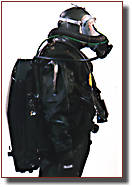
The results of this are seen in the remarkable StealthTM closed-circuit, autonomous
re-breather for the military market. As its name suggests, this self-contained diving set
is designed to enable military divers to move in on a target, undetected without the
usual tell-tale stream of air bubbles.
In the longer term Derek Clarke sees some of the StealthTM technology finding its way
into the mainstream diving market, particularly where diving operations involve enclosed
areas or tunnels.
One of the other recent fruits of research and development activity has been the new Dirty Harry system, designed for use in
contaminated water. Previously free-flow helmets have been used to keep contaminated water
from seeping into the diver's helmet, but the noise level means that these helmets
are being phased out. In any case they are inefficient in terms of gas usage and do not
have an emergency bale-out supply.
Rather than exhaling through the usual water leakage point of a mushroom valve, the
Dirty Harry system cleverly exhausts through a specially adapted two stage valve. Air is
returned to the surface without any possibility of contact with the polluted water.
From the Deep South to the North Sea
The Divex name traces its roots back to Louisiana. In the town of Harvey just
across the Mississippi from New Orleans Divers Exchange opened its doors in 1974. Here
in the early days as the name might imply divers were encouraged to trade-in
second-hand equipment against their new purchases.
It is quite a leap, however, for a company with its roots in America's Deep South
to become one of the leaders in the offshore business, based in Aberdeen, Scotland. How
did it come about?
The first stage in the move across the Atlantic came when Divex opened a satellite
office in Great Yarmouth. Then, as the commercial diving emphasis moved away from the Gulf
of Mexico to the North Sea, the original American company closed its doors and the UK
operation became the sole survivor.
Enter Sub Sea Services. Originally a scuba diving shop, the owners spotted the
potential in the oil industry market in Aberdeen. And, in 1975, a young David Smith now
Sales Director of Divex Ltd was dispatched to the oil capital to set up shop.
"It was an exciting time for me, because the diving market in Aberdeen was
developing so quickly. It was quite a vibrant market," David recalls.
Sub Sea Services expanded rapidly over the coming years with a series of acquisitions.
It took over the Divex business, then Submarine Products and entered the hire business
with its acquisition of Maritime Marketing.
"The main thrust of our business then was to be a manufacturer of products,
rather than being just a supplier," says David Smith. "Nothing has really
changed and that philosophy applies today. Our aim with Divex is to manufacture a broad
range of equipment using supplier's products, where necessary, to fill in gaps in
our own range."
Identifying mixed gas potential
From humble beginnings in his garden shed in Chertsey, in the suburbs of London, John
Mills produced high-technology sonar and seismic equipment for the marine survey and
oceanographic industry.
That was in 1966, and over the coming years UWI, or Underwater Instrumentation to give
it its full name, established a strong reputation with its clients. So strong, in fact,
that there was a growing customer demand for it to supply commercial diving equipment.
UWI moved to premises in Addlestone, West of London, and in 1976 opened an office in
Aberdeen to service the growing offshore business.
In those days, there was little domestically-produced commercial equipment which was
suitable for the expanding offshore market and UWI took on key supply agencies and also
developed its own Dive Dynamics range to cater for air diving up to 50 metres.
David Dent now Marketing Director of Divex was the manager of UWI's Aberdeen
operation. He had developed an interest in diving in his childhood back in New Zealand and
following a career in engineering which took him first to Africa, he moved to Aberdeen.
The growing offshore diving business was a natural draw.
"I identified potential for mixed gas ancillaries, but UWI were very committed to
air diving," he explains. "I soon realised that, if I was going to develop the
mixed gas market, I would have to do so myself."
That was the cue for the formation of Circle Offshore in Aberdeen, which began business
in 1984.
It is an indication of how right David was to follow this route, that ten years
later he merged with his former employer and formed UWI Circle under the umbrella of
the Circle Offshore Group.
"The rationale was very similar to that which applied to the Divex and UWI Circle
merger last year," David recalls. "Everyone in the industry was under pressure
due to a tight market. We had to consolidate to keep costs in check."
The other Circle Offshore Group company, Circle Technical Services, formed in 1990,
was the result of organic growth.
As with Divex, Circle Technical Services operates internationally in the Middle East,
Far East and West Africa. A sister company, Gulf Circle, is based in Abu Dhabi.
"Most of Circle's work is cold cutting work on pipelines, conductors and
damaged platforms," says David. "For example, we've recently been cutting
out a damaged section of a platform in the Red Sea, following a collision with a service
vessel and we're also working there on fitting marine growth preventers on platforms
in the same vicinity."
Developing the business
It was Derek Clarke's interest in sports diving that lured him away from his
position as a graduate engineer with British Aerospace.
When the opportunity arose to join Strongwork Diving in Wales, in 1975, he seized it
and began working on the design and building of saturation diving vessels.
The expanding offshore market in Aberdeen spurred a move, with Strongwork, to Aberdeen
where he became their Technical and Marketing Manager in 1977. A year later he moved to
Wharton Williams, where he was in charge of the engineering department.
But Derek saw an opportunity for an underwater engineering consultancy business.
In 1983, he realised his ambition setting up Mara Engineering, which takes its name
from the Scottish Gaelic word for ‘sea'.
"In three years the business continued to expand, to the point where we had 20
people and our own engineering and fabrication facility," Derek explains. "But
the business world can throw in some nasty surprises and ours came when the oil price
collapsed in 1986."
It was time for a reappraisal. At this time the diving industry in the North Sea was
maturing and much of the large capital equipment had already been purchased. As a result
of both these factors, the market was contracting. "We began talking with Gas
Services and realised that joining forces made sense to both parties," Derek recalls.
The companies came together and Derek took on the role of Managing Director of Gas
Services with a new group holding company, the Pressure Products Group was formed.
Mara Engineering continues as the bespoke engineering division of Divex, with its
manufacturing base at Kidderminster. As part of the post merger reorganisation of Divex,
Mara's operations are being integrated within Divex to create a one-door approach for
the complete range of subsea, hyperbaric and diving engineering projects.
Gas Services had been founded on the success of the Helinaut valve and had diversified
into supplying gas to the industry. This was a new area for Derek Clarke and he recalls
that not all the work was oil related.
Among the more unusual projects, Gas Services supplied the controlled atmosphere for
keeping Scottish strawberries fresh and produced high-specification gases for use in
Scotland's Silicone Glen!
The strategic alliances continued with Gas Services expanding its business through
further acquisitions.
General Diving Systems was acquired in 1988 to consolidate the Gas Services product
line and to reduce the joint overheads. Then came the acquisition of Sub Sea Services and
Divex, followed by Offshore Marine Engineering and Seaforth Kinergetics a company that
can trace its history back to Barry, Henry and Cook, one of the oldest engineering
companies in Aberdeen.
Continuing the dynamic progress, the new management team successfully fronted a
management buyout in 1990.